




A Webflow site in 2026 costs between €1000 for a landing page and several thousand euros, depending on the project's scope. There are two main cost categories: the Webflow subscription (site plan including hosting, SSL, and CDN) and the design service. A simple showcase website does not have the same budget or timeline as a complex site with a member area.
The million-dollar question everyone is asking
It's the first thing I'm asked on a discovery call. Even before we talk about the project, timeline, or objectives: " how much does it cost? ". And every time, I have to give the same answer: "it depends." Not out of laziness, but because it's the truth. A 5-page website for a sports coach and a 30-page website with a member area for a training school are not the same project, don't have the same budget, and don't follow the same timeline.
The problem is that when you search on Google, you find ranges so wide they're useless. "Between €500 and €50,000" — thanks, very helpful. What I'll try to do here is lay out the real figures I see daily in my work as a Webflow developer, break down each cost item, and give you enough clarity to build a realistic budget.
The cost of Webflow as a platform
Let's start with the simplest. Webflow is a monthly subscription. There are two types of plans: site plans (which include hosting, SSL, CDN, etc.) and workspace plans (for managing team access). As an end client, the site plan is what concerns you. Workspace plans are your service provider's concern.
What's clever about Webflow is that the free plan allows you to get a first glimpse and create a few pages. However, if your site needs more pages, CMS collections, or domain name connection, you'll have to get a paid plan.
The four available site plans
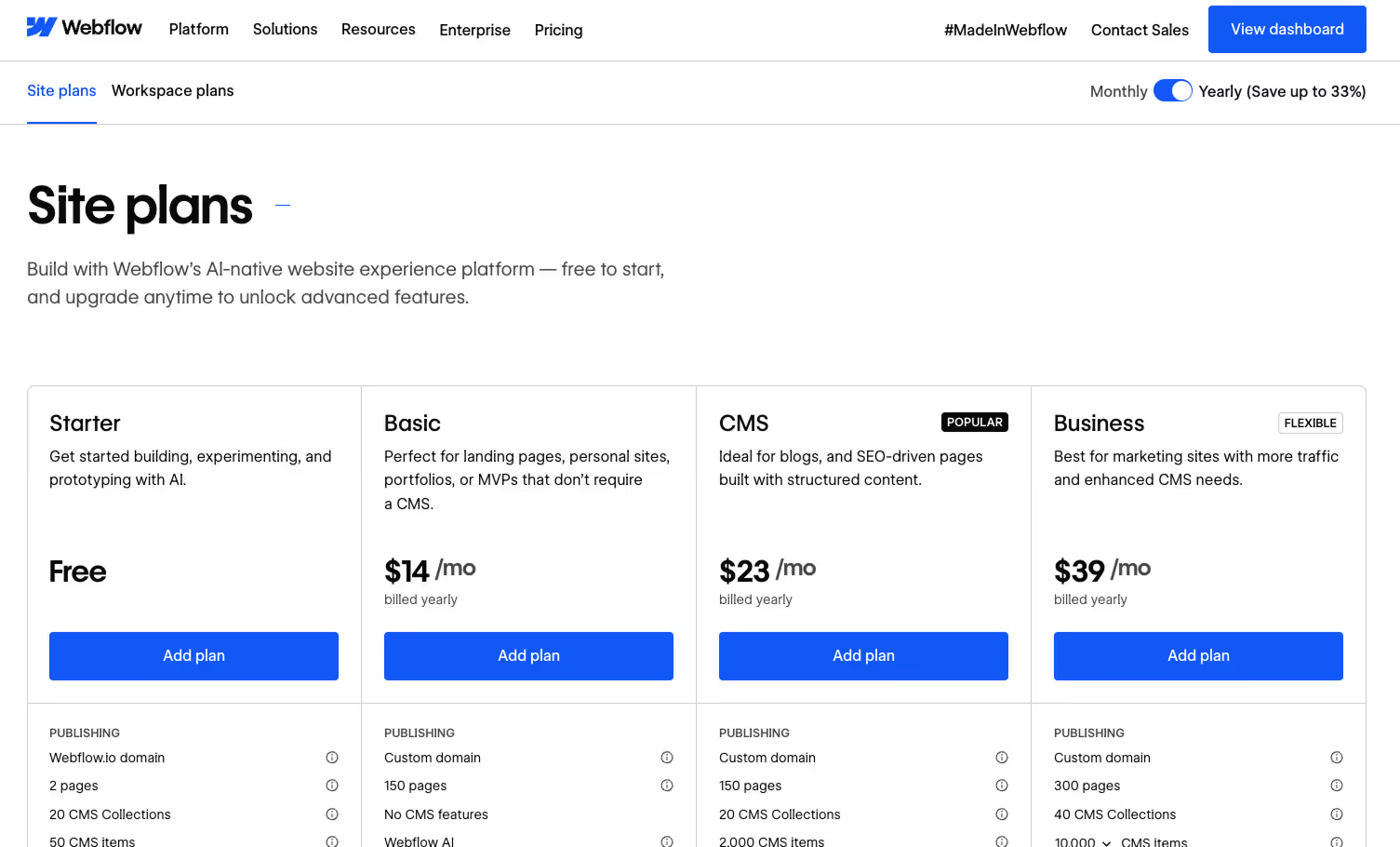
The Basic at $14/month does the job for small showcase websites or landing pages. You get your custom domain, 150 static pages, but no CMS capabilities, making it difficult to scale if you plan to grow quickly.
The CMS at $23/month, that's the one I implement most often. As soon as there's a blog, a portfolio, dynamic testimonials, or any form of content that evolves over time, this plan is essential. It supports up to 2,000 CMS items and unlocks most features. It's the sweet spot for most SME projects.
The Business plan at $39/month comes into play when the site starts generating significant traffic or when more advanced third-party integrations are needed. It includes 10,000 CMS items, 400 GB bandwidth, and advanced forms. I typically recommend it for ambitious content sites, e-commerce businesses, or organizations that publish very regularly.
TheEnterprise plan is by quote, reserved for large organizations with specific security or compliance requirements. If you're reading this article, chances are this plan isn't for you.
And for all the details, feel free to check out the pricing on the Webflow page.
The extras that can add to the bill
Two items regularly appear in my quotes and often surprise my clients.
The first is Webflow Localization. If you need a bilingual or multilingual site, this option adds between $9/month (Essential plan) and $29/month (Advanced plan) per additional language. I consistently recommend the Advanced plan because it allows for URL translation, which is crucial for international SEO. Specifically, for a French-English site on a CMS plan with Advanced Localization, you're looking at $29 + $29 = $58/month.
The second is e-commerce. Webflow e-commerce plans start at $29/month and go up to $212/month. For a site selling physical products, the Webflow bill alone can exceed $250/month, which legitimately raises the question of Shopify as an alternative in this specific niche, and which, in my opinion, will be much more effective if you have a large product database to sell.
The true cost of building a website
The Webflow subscription is like the rent for your premises. Building the website is the structural work.
What many people don't realize is thata professional website doesn't start in Webflow. It starts with a strategic conversation. What should your site achieve? Who are your target visitors? What journey should they take to convert? This upfront strategic thinking is what separates a website that converts from a pretty site that serves no purpose.
Then comes the phase of UX/UI design. Figma mockups, client iterations, validation of each page even before touching Webflow. Then technical integration, CMS structuring, the configuration SEO, responsive testing across all formats, and training so the client can manage their content independently. Each step takes time. And it's this time that determines the price.
The rates I observe in the French market
I should specify that these ranges correspond to what experienced freelancers in France charge in 2026. The Webflow agencies generally charge significantly more for comparable services, due to their overhead costs.
A classic brochure website of 3 to 5 pages — home, about, services, contact — with a custom design and basic SEO, is priced between €2,500 and €3,500. This is the typical project for a consultant, coach, architectural firm, or artisan who wants a polished online presence. Timeline: 2 to 4 weeks generally, including validation rounds.
When moving to a more ambitious website of more than 10 pages with a blog, sophisticated animations, detailed service pages, and a well-thought-out CMS, the price range is €3,500 to €6,000. The timeline extends to 4 to 8 weeks, depending on the client's responsiveness regarding content and validations.
The Webflow e-commerce sites range from €5,000 to €10,000. The difference is huge because a site with 20 products and a simple checkout is nothing like a catalog of 500 items, multiple variants, dynamic promotions, and logistics integration. And for custom projects — member areas via Memberstack, dynamic calculators, API integrations, automated workflows, etc. — prices typically start around €7,000 with no defined upper limit, because technical complexity is the only real limiting factor.
Website pricing: what varies by project type
So far I've talked about Webflow, but most people looking for a budget simply type " cost of a brochure website " or " how much does a website cost ". The logic is the same regardless of the tool: what determines the price of a website is not the technology, but the amount of design, content, and integration work involved. Here are concrete benchmarks by site type, valid for an experienced freelancer in France.
If you prefer, you can request a custom quote for your next project.
How much does a website redesign cost?
A redesign is a special case because you're not starting from a blank slate: there's an existing site to analyze, content to retrieve, and most importantly, SEO to preserve. This is precisely where many projects go wrong — a poorly managed redesign can cause traffic to plummet overnight.
The price of a website redesign depends on the scope of the project. A purely visual redesign, keeping the same page structure, is similar in cost to a new brochure website: between €2,500 and €4,000. A complete redesign — new sitemap, content migration, existing SEO recovery, and migration to Webflow from WordPress or another CMS — typically falls between €4,000 and €8,000.
The aspect never to neglect during a redesign is lossless SEO migration : clean 301 redirects, preservation of high-performing URLs, tag and internal linking transfer. This is invisible on a quote from a provider who doesn't master it, and very costly to fix if it's botched. If you're considering a redesign, let's discuss it beforehand: contact me to define the scope before you commit.
Why two quotes can vary so widely
I often receive messages from prospects who tell me, "I received one quote for €1,200 and another for €4,500 for the same website, how is that possible?" The answer is, it's not the same website.
The €1,200 quote usually involves a slightly modified template, no strategic thinking, no prior mock-ups, client-provided texts copied and pasted as-is, symbolic SEO, and a 15-minute training session to deliver the site. The €4,500 quote is a real in-depth job: existing site audit, information architecture, Figma mock-ups validated together, Webflow integration by a certified expert, content developed and restructured for conversion, advanced technical SEO, comprehensive training, and post-launch follow-up.
The difference isn't necessarily visible on the day of launch. It becomes apparent three months later, when the first site generates no leads and the second brings in quote requests and new prospects every week.
Cost drivers
The custom design is the primary lever. A customized template costs less than a full creation in Figma with iterations and creative back-and-forth. Both approaches have their merits, but they tell a different story to your visitors. A generic site will be perceived differently from one where every detail reflects your positioning.
The animations are another variable cost item. Native Webflow interactions — scroll-triggered appearances, hover effects, page transitions — are quick to implement. But as soon as we talk about advanced GSAP animations — parallax, letter-by-letter text animations, complex timelines synchronized with scrolling — development time skyrockets. A site with well-executed custom animations can require 2 to 3 days of work just for this part.
The content writing is often missing from many quotes. Yet, a website without optimized content is like a Ferrari without gas. If your service provider has to write the texts, structure them for SEO, choose the right keywords, and create a coherent content architecture, that's work that needs to be paid for.
And the technical SEO, I'm coming back to this because it's a point I feel strongly about. The search engine optimization isn't limited to just filling in title and description fields. True technical SEO on Webflow involves schema.org structured by page type, dynamic meta tags linked to the CMS, a clean sitemap, Core Web Vitals optimization, thoughtful internal linking, and increasingly optimization for artificial intelligence. This work is rarely included in a basic quote, yet it's what makes the difference between an invisible site and one that captures qualified traffic.
All the costs we don't think about early enough
I often tell my clients that the website itself is just the tip of the budgetary iceberg. Here are the items below the waterline that deserve to be anticipated from the start.
The domain name might seem trivial — between €10 and €30/year depending on the extension — but it's a strategic choice that impacts your image and your SEO. A .fr inspires confidence in the French market, while a .com is essential if you're targeting international audiences.
The visual content is often the neglected aspect of web projects. Yet, quality images do as much for your site's credibility as the design itself. A professional photo shoot, even a modest one, literally transforms the perception of your business.
The search engine optimization deserves a dedicated budget, separate from the website creation. An initial SEO audit with technical optimizations costs between €500 and €2,000. But SEO is a marathon, not a sprint. It's an investment that takes a few months to bear fruit, but then generates a stream of qualified visitors without spending a cent on advertising.
The third-party tools progressively accumulate as you grow: newsletter solutions like Brevo or Mailchimp, analytics with GA4 or CRM, online appointment scheduling tools like Calendly. The advantage is that most offer free plans to start. You only pay when your activity volume justifies it, which means you typically have the means to finance them when they become necessary.
My perspective after dozens of projects
After designing and developing dozens of Webflow sites over the past few years, the most frequent observation is quite counter-intuitive: it's not the clients who spend the most that get the best results. It's those who invest in the right place.
A client who invests €10,000 in a magnificent website but zero euros in content and SEO ends up with an invisible site that no one but them will ever see. Another who invests €3,000 in a clean and efficient site, then maintains quality SEO content long-term, will receive regular contact inquiries. Budget allocation matters as much as the total amount.
My most sincere advice: don't choose your service provider based solely on price. A good Webflow freelancer doesn't just move blocks around. They ask questions about your goals, challenge your brief, structure your site for conversion, and empower you for the future. This expertise comes at a cost, but it pays for itself in a few months when the first leads start coming in.
Do you have a project in mind and want to know where you stand budget-wise? Contact me for a no-obligation discussion.
FAQ
How much does a professional showcase website cost?
A 3-5 page brochure website with custom design and basic SEO typically costs between €2,500 and €3,500 when working with an experienced freelancer in France. The price varies depending on the level of design customization, content creation, and the depth of SEO.
How much does a freelance Webflow developer cost?
A freelance Webflow developer typically charges per project, not hourly. For a complete showcase website, expect to pay €2,500 to €3,500; for a site with CMS and blog, €3,500 to €6,000. A freelancer is generally less expensive than an agency while offering comparable quality, as they don't have overhead costs to pass on.
What budget to expect for a website redesign?
A visual redesign costs between €2,500 and €4,000. A complete redesign, including a new site structure, content migration, and the preservation of existing SEO, ranges from €4,000 to €8,000. The critical point is SEO migration without traffic loss, which needs to be defined from the outset.
Why can two quotes for the same website vary by as much as double?
Because it's almost never the same website. A low quote often means a slightly modified template, lacking strategic thought or serious SEO. A higher quote includes an audit, mockups, expert integration, content optimized for conversion, and genuine technical SEO. The difference becomes clear three months later, in the leads generated.
Is the Webflow subscription cost included in the website price?
No, the Webflow subscription is a separate recurring cost, borne by the client. Expect approximately $14 to $39/month depending on the plan, plus any additional options (e.g., Localization for multilingual sites, e-commerce). This cost covers hosting; it is in addition to the website creation cost.


